Sistema
Automatico
Valorizzazione
Extraprofili
Automatico
Valorizzazione
Extraprofili
CUP J49I24001730005

Completion percentage
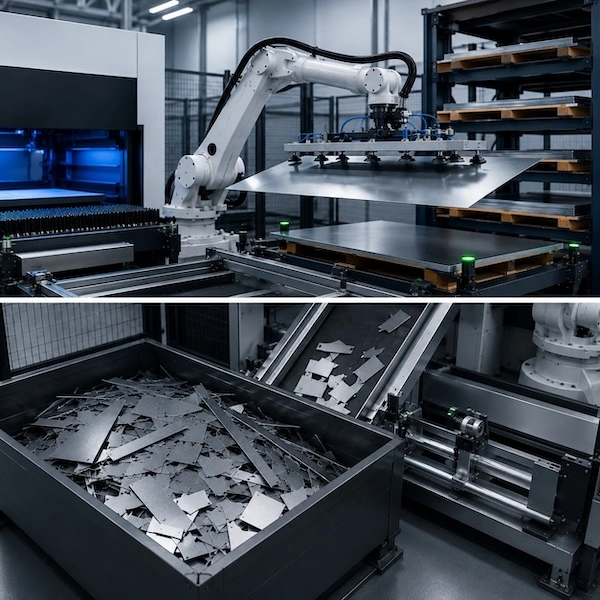
Sheet metal nesting is a technique used in the mechanical industry to optimize material usage by reducing waste. This methodology consists of positioning the shapes to be cut as close as possible to one another within a sheet metal panel, minimizing the empty spaces between them.
There are numerous nesting software solutions that use heuristic algorithms to optimize the arrangement of shapes on the sheet metal panel, since the complexity of the problem is exponential (NP-Hard problem). These software solutions can take into account various factors such as sheet dimensions, cutting constraints, orientation constraints, and the required quantities for each part.
Cutting technology usually refers to laser or plasma sources or, in limited cases, to mechanical punching machines that still perform cuts precise enough to be compatible with geometric nesting, since the cut parts do not show evident burrs, especially when made from thin sheet metal. However, particularly in companies carrying out small-batch production, standard-size sheet metal panels are not fully utilized and, when the cutting phase resumes, due to issues related to repositioning and measuring the “remnants,” huge amounts of scrap are often generated and removed from the production line to be processed by recycling companies.
Compared to the current state of the art, the SAVE project pursues the following objectives:
- reduction of scrap through the digital and physical storage of “remnants” from previous processes
- greater speed in cutting small parts of different thicknesses, since there is no need to handle entire sheet metal panels
- increased operator safety, as loading and unloading operations will no longer be performed manually.
The support of a robotic system capable of performing the pick-and-place of the “remnants,” whose geometry is detected online and archived within the “pre-cut” warehouse, makes it possible to achieve the project goals, representing a significant innovation compared to the current state of the art.
Project partner



This initiative is carried out with the contribution of the European Union
If you are interested, learn more about this project